Western red cedar is the gold standard for Alaska fencing — naturally resistant to rot, insects, and the brutal temperature swings that destroy lesser materials. We've been building cedar fences across Southcentral Alaska for over 30 years.
Not every wood species can handle what Alaska dishes out. From January lows of -30°F to summer highs pushing past 70°F, your fence endures a 100-degree temperature swing every single year. That relentless freeze-thaw cycle cracks, warps, and splits most lumber within a few seasons. Western red cedar is the exception.
Cedar's secret lies in its cellular structure. The wood is loaded with natural oils and extractives — primarily thujaplicins and thujic acid — that act as built-in preservatives. These compounds repel moisture, resist fungal decay, and deter wood-boring insects like carpenter ants and beetles, all without the chemical pressure-treatment that other species require. That means no arsenic, no chromium, no copper leaching into your soil near gardens and play areas.
The tight, straight grain of Western red cedar also gives it exceptional dimensional stability. While pressure-treated spruce and pine twist and cup as they absorb and release moisture through Alaska's seasons, cedar holds its shape. Boards stay flat. Joints stay tight. Your fence looks as good in year ten as it did the week we built it.
Left untreated, cedar gracefully darkens to a distinguished silver-gray patina that blends beautifully with Alaska's natural landscape. Prefer to keep the warm reddish-brown tones? A quality oil-based sealant applied every two to three years during summer preserves the original color for decades.
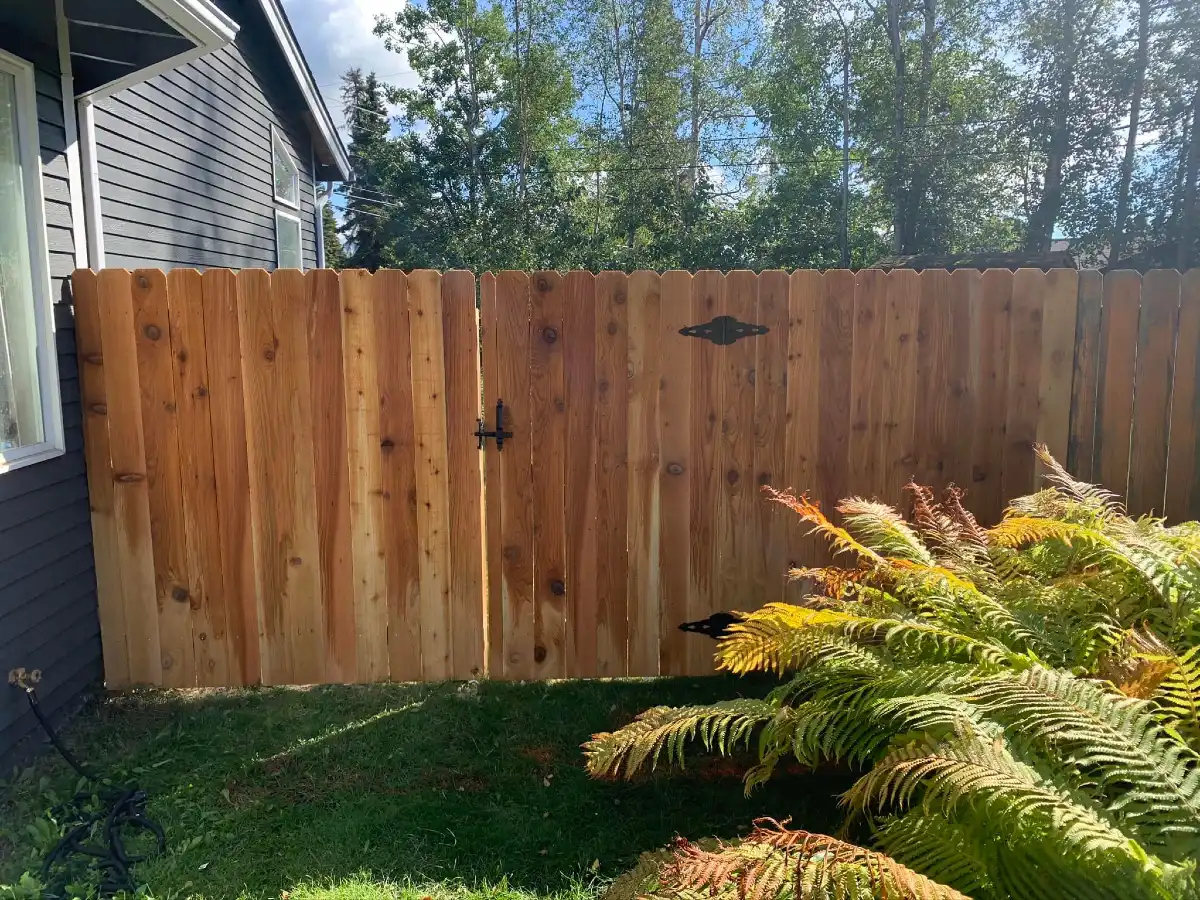
Every property is different. We offer four proven cedar fence designs, each engineered for Alaska's conditions and customizable to your taste.
Our most popular cedar fence style. Solid board-on-board construction at 6 feet tall delivers complete privacy from neighbors, windbreak protection, and sound dampening. Ideal for backyards, hot tub enclosures, and pet containment.
Overlapping cedar boards create a fence that looks finished from both sides — no "bad side" facing your neighbor. The overlapping design also makes this style exceptionally wind-resistant, a critical factor in Anchorage where Chinook gusts can exceed 60 mph.
Clean horizontal slats deliver a contemporary aesthetic that complements modern architecture and mountain views. Adjustable spacing between boards lets you balance privacy with sightlines to the Chugach Range or Cook Inlet.
Classic American charm in Western red cedar. Our picket fences define property boundaries and front yards with warmth and character. Available in pointed, flat-top, and French Gothic picket profiles at 3 to 4 feet tall.
From first phone call to final walkthrough, here is exactly how we build your cedar fence — no surprises, no hidden steps.
We visit your property, walk the fence line, measure the lot, and check for underground utilities through Alaska Dig Line. We discuss your design preferences, privacy needs, gate placement, and any terrain challenges like slopes, tree roots, or rock.
You receive a detailed plan showing post locations, gate positions, and material specifications. Our quote includes everything — materials, labor, concrete, hardware, and cleanup. No hidden line items. Financing available for qualified buyers.
We drill post holes 42 to 48 inches deep to clear Alaska's frost line — nearly double the depth required in the Lower 48. Proper spacing (typically 6 to 8 feet on center) ensures structural integrity against Anchorage's notorious Chinook winds.
Pressure-treated 4x4 or 6x6 posts are set plumb and anchored in high-strength concrete rated for cold-weather curing. We use pressure-treated lumber for below-grade posts to resist ground moisture while the above-grade fence uses premium Western red cedar.
Precision-cut Western red cedar rails are fastened level to each post. Pickets are installed with consistent spacing using stainless steel or hot-dipped galvanized fasteners that won't rust or stain the wood. Every board is checked for plumb and alignment.
We walk every linear foot of your new fence with you, checking gates, latches, and overall finish quality. We clean up all debris and leftover materials, then provide a printed maintenance guide specific to cedar fencing in Alaska's climate.
Alaska's extreme seasons demand a maintenance approach that's nothing like what you'll find in a generic home improvement article. Here is the real seasonal playbook.
Spring is inspection season. Walk your entire fence line and look for frost heave damage — posts that have lifted or tilted over winter. Check every post for stability by pushing firmly at the top. If a post rocks, it likely needs to be re-set below the frost line. Clean any green mildew or algae with a diluted oxygen bleach solution (not chlorine bleach, which damages cedar fibers). Rinse with a garden hose — never a pressure washer, which gouges the soft cedar grain.
This is your only staining window. Alaska gives you roughly three months when temperatures stay consistently above 50°F, which is the minimum for oil-based stain to cure properly. Apply a UV-resistant, semi-transparent penetrating stain to all exposed cedar surfaces. Pay special attention to end grain on the tops of pickets and posts, where moisture wicks in fastest. Stain every 2 to 3 years to maintain color and protection.
Before the first hard freeze, tighten any loose fasteners and replace boards that have cracked or split. Clear leaves, brush, and debris from the base of the fence line — trapped moisture against the bottom rail accelerates rot. Trim back any vegetation growing against the fence. This is also a good time to verify that gate latches operate smoothly before ice and snow complicate adjustments.
Monitor snow accumulation along the fence. The single most damaging thing homeowners do to their cedar fences in Alaska is pile plowed snow against them. That concentrated weight bows panels, snaps rails, and pushes posts out of plumb. Direct your snow removal away from the fence line. If heavy wet snow builds up naturally, knock it free with a broom before it freezes solid against the wood.
We offer cedar fence staining, sealing, and repair services for existing fences — even ones we didn't build.
Schedule Service →A well-maintained Western red cedar fence in Alaska typically lasts 20 to 30 years. Without regular staining and sealing, you can still expect 15 to 20 years of solid performance thanks to cedar's natural resistance to rot and insects. The key to longevity in Alaska is proper post depth (42 to 48 inches to clear the frost line), quality sealant application during the short summer window, and keeping snow cleared away from the base of the fence. With our construction methods and the maintenance guidance we provide, many of our cedar fences from the 1990s are still standing strong today.
We recommend oil-based penetrating stains with a semi-transparent finish. Oil-based formulas soak into the cedar grain rather than forming a surface film, which prevents peeling and cracking during freeze-thaw cycles. Semi-transparent finishes let the natural wood grain show through while providing UV protection during Alaska's long summer days (up to 19 hours of sunlight in June). Avoid latex or solid stains — they form a rigid film on the surface that cracks when the wood expands and contracts through our extreme temperature range. Re-apply every 2 to 3 years, and only stain when temperatures are consistently above 50°F, which limits your window to June through August.
In Anchorage, fence posts must be set 42 to 48 inches below grade to reach below the frost line. This is nearly double the 24-inch depth standard in most Lower 48 states. Alaska's deep seasonal frost penetration means that any post bottoming out above the frost line will be lifted and tilted by frost heave as the ground freezes and thaws. We use pressure-treated 4x4 or 6x6 posts set in high-strength concrete for maximum resistance to heave. In areas with particularly poor drainage or heavy clay soils (common in parts of Anchorage's Hillside), we may go even deeper or add gravel backfill beneath the concrete to improve drainage around the post base.
Yes, with some caveats. We can set posts in frozen ground year-round using heavy-duty auger equipment capable of drilling through frozen soil and even hitting bedrock. Cold-weather concrete formulas cure properly at temperatures other mixes cannot handle. However, full fence installation — including rail attachment and picket work — is best completed between April and October. Cold-weather lumber is more brittle and prone to splitting during nailing, and short daylight hours in winter limit productive work time. Our recommended approach is to schedule winter post-setting so your fence is ready for rail and picket work as soon as the spring thaw hits, giving you first priority in our building season schedule.
Cedar fence costs in Anchorage typically range from $35 to $65 per linear foot installed, depending on style, height, and terrain. Standard 6-foot privacy fences and board-on-board designs fall on the higher end, while 3 to 4-foot picket fences are more affordable. Factors that affect pricing include lot slope and grading requirements, underground utility proximity, number and size of gates, total fence length, and soil conditions. Longer fence runs generally cost less per foot due to material and labor efficiencies. We offer free, no-obligation estimates and flexible financing options. Call us at (907) 302-1819 or fill out the form below to get your personalized quote.
Thank you for reaching out. Our team will contact you soon to schedule your free estimate.