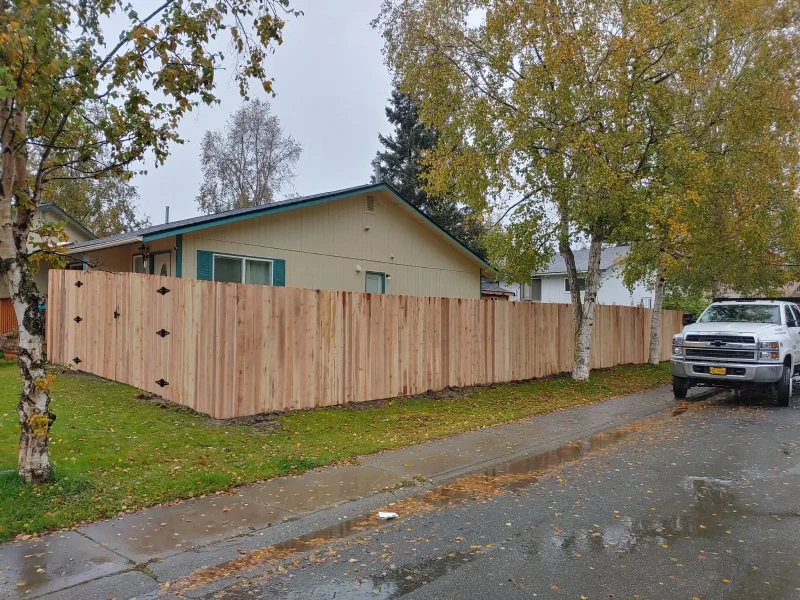
Alaska's extreme weather is tough on fences. From frost heave and storm damage to moose encounters and heavy snow loads, we've repaired every type of fence damage imaginable over 30+ years of service.
Alaska's climate creates unique challenges that fences in the Lower 48 never face. Understanding these threats helps you catch problems early.
The most common fence problem in Alaska. When soil freezes, it expands and literally pushes fence posts upward and out of the ground. Posts set too shallow (less than 42 inches) are especially vulnerable. Over several freeze-thaw cycles, posts can heave 4-8 inches above their original position.
Anchorage experiences powerful Chinook winds that can exceed 60+ mph, particularly in the Hillside and Turnagain areas. These sustained gusts snap fence rails, tear pickets loose, and push entire fence sections over. Solid cedar fences catch more wind load than chain link.
This is a uniquely Alaska problem. Adult moose weigh 1,000-1,500 pounds and regularly walk through residential neighborhoods in Anchorage, Eagle River, and the Mat-Su Valley. They walk through solid fences they cannot see, lean over shorter fences to browse vegetation, and calves sometimes get tangled in chain link.
Anchorage averages 75 inches of snowfall per year. Snow piled against fences by plows or drifting adds enormous weight — a cubic foot of packed snow weighs 20-30 pounds. This breaks rails, snaps pickets, and pushes fence sections sideways. The weight of ice buildup is even worse.
Anchorage sits in an active seismic zone. The November 2018 magnitude 7.1 earthquake shifted foundations and fence posts across the city. Even smaller quakes (3.0-5.0) that occur regularly can gradually shift post alignment over time, especially in areas with loose glacial silt soil.
Even the best-maintained cedar fence will eventually show its age. In Alaska, the combination of moisture, UV exposure during long summer days, and freeze-thaw cycling accelerates wood deterioration. Posts rot at the ground line first, where moisture concentrations are highest.
No fence repair is too big or too small. We work with all fence types and materials.
With over 30 years of repairing fences in Anchorage and the surrounding areas, we've seen every type of damage Alaska can dish out. Our repair services cover:
Making the right call saves you money. Here's how to decide.
| Factor | Repair Makes Sense | Replacement Is Better |
|---|---|---|
| Post damage | 1-3 posts affected | More than 30% of posts leaning or heaving |
| Board/picket condition | Isolated broken or missing boards | Widespread rot, splitting, or warping |
| Fence age | Under 15 years old | Over 20 years with multiple issues |
| Rails | One or two rails sagging | Rails rotting or splitting in multiple sections |
| Foundation | Concrete footings intact | Concrete crumbling, posts pulling free |
| Cost comparison | Repair cost is under 40% of replacement | Repair cost approaches 50%+ of replacement |
Not sure which way to go? We provide honest, no-pressure assessments. If repair will hold, we'll tell you. If replacement is the smarter investment, we'll explain exactly why.
Some fence damage can't wait for a scheduled appointment. A downed fence section means your dogs can escape, your property is unsecured, or a walkway is blocked. We understand the urgency.
Our emergency repair service covers:
We can often secure the damaged area on the same day with a temporary fix and schedule full repair within 24-48 hours. Call (907) 302-1819 for emergency service.
Same-day temporary securing available. Call now for urgent fence damage.
(907) 302-1819The best repair is the one you never need. Regular maintenance extends your fence's life and catches small problems before they become expensive.
After the last freeze-thaw cycle, check every post for heaving or leaning. Look for boards that cracked during winter. Test gates for smooth operation. This is the most critical inspection of the year — winter damage is often invisible until spring.
June through August is your window for staining, sealing, and major repairs. Re-stain cedar fences every 2-3 years. Tighten loose hardware. Trim vegetation growing against the fence — it traps moisture and accelerates rot.
Before the ground freezes, secure any loose boards or rails. Make sure posts are plumb — a post that enters winter slightly leaning will be much worse by spring. Clear the fence line of debris that could trap snow and moisture.
Avoid piling plowed snow against your fence — the weight and moisture cause more damage than anything else. If you notice a section leaning under snow load, carefully remove snow from both sides. Report major damage early for faster spring repair scheduling.
Tell us about the damage and we'll provide a free on-site assessment.
Thank you for reaching out. Our team will contact you soon to schedule your free estimate.